GST Invoice Format in India: Mandatory Fields, Examples and Common Mistakes
What a valid GST tax invoice must contain under Rule 46: every mandatory field, how to number invoices, when to charge CGST and SGST versus IGST, and the mistakes that get invoices rejected.
In this article
A GST invoice format that is accepted everywhere does not exist as a single template, but what it must contain is fixed by law. If you are a registered business in India, every taxable sale needs a tax invoice with the right details, because your buyer cannot claim input tax credit without one and a mistake can hold up your own returns. This guide walks through every mandatory field, how to number invoices, how to split the tax, and the mistakes we see most often.
What is a GST tax invoice?
A tax invoice is the document a GST-registered supplier issues for a sale of taxable goods or services. It records what was sold, to whom, at what value and how much GST was charged. The contents are set out in Rule 46 of the CGST Rules, 2017. The layout, fonts and logo are up to you; the information is not.
Mandatory fields on a GST invoice
Under Rule 46, a tax invoice must show the following:
Your details: name, address and GSTIN.
Invoice number and date: a unique serial number (see the numbering rules below) and the date of issue.
The buyer's details: name, address and GSTIN if the buyer is registered. For an unregistered buyer, the name, address and delivery address plus the state name and state code are required when the invoice value is ₹50,000 or more.
HSN or SAC code: the HSN code for goods or the accounting code (SAC) for services. The number of digits you must show depends on your annual turnover, so check the current notification.
Description, quantity and unit: what was sold, and for goods how much of it.
Values: the total value, any discount, and the taxable value after discount.
Tax rate and amount: the rate and amount of CGST, SGST or UTGST, IGST and cess, as applicable.
Place of supply: with the state name for inter-state supplies, and the delivery address if it differs.
Reverse charge: whether tax is payable on reverse charge.
Signature: yours or your authorised representative's, which can be digital.
Invoice numbering rules
The invoice number is where many businesses slip. It must be a consecutive serial number of at most 16 characters, made up of letters, numbers, a hyphen or a slash, and it must be unique for the whole financial year. You may run more than one series, for example one per branch, as long as each number is still unique.
Gaps in a series invite questions in an audit, so avoid creating a number for a document you then throw away. The safest habit is to assign the number only when the invoice is final.
CGST and SGST, or IGST?
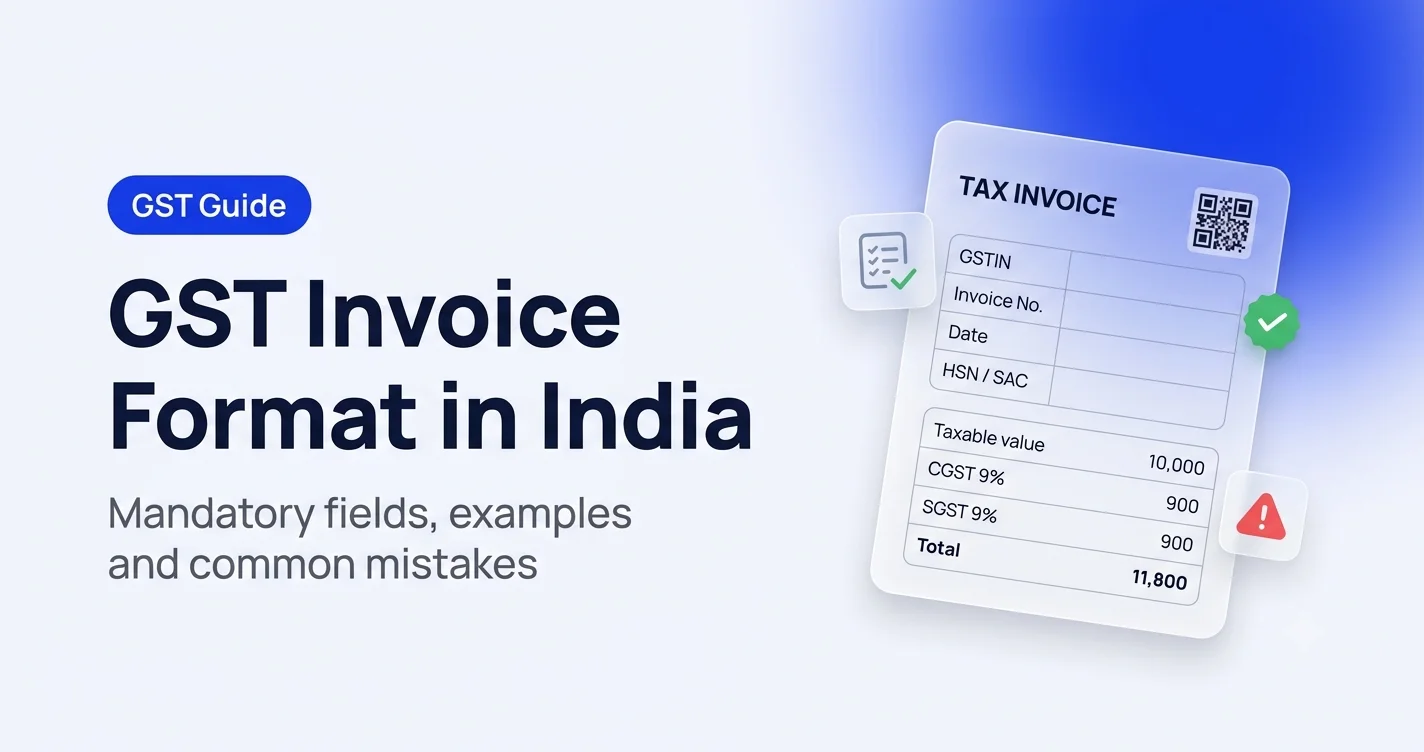
What decides the tax split is the place of supply, not just where your office is. If the place of supply is in your own state, you charge CGST and SGST (or UTGST in a union territory) in equal halves. If it is in another state, you charge IGST. Take a sale with a taxable value of ₹10,000 at 18% GST:
Supply | Tax charged | Invoice total |
|---|---|---|
Within the same state | CGST 9% = ₹900 and SGST 9% = ₹900 | ₹11,800 |
To another state | IGST 18% = ₹1,800 | ₹11,800 |
The total is the same either way; what changes is which government the tax goes to and how the buyer claims credit. Choosing the wrong one is among the most common reasons an invoice has to be corrected.
When must you issue the invoice?
For goods, issue the invoice at or before the time the goods are removed or delivered. For services, issue it within 30 days of providing the service (45 days for insurers, banks and other financial institutions). Issuing late is a compliance issue even if every detail is right.
Bill of supply, credit notes and e-invoices
Not every sale needs a tax invoice. A business under the composition scheme, or one selling exempt goods or services, issues a bill of supply instead and does not charge GST on it. If you need to reduce the value of an invoice already issued, for returned goods or a discount agreed later, you issue a credit note, and a debit note if the value goes up.
Businesses above the e-invoicing turnover limit (₹5 crore when we last checked, so confirm the current figure on the GST portal) must report each B2B invoice to the government's Invoice Registration Portal and print the resulting IRN and QR code on it.
Good to know: an IRN can only be issued by the government portal. Software can prepare the data and store the IRN, but a number that was not issued by the portal is not valid.
Common GST invoice mistakes
Mistake | Why it matters | Fix |
|---|---|---|
Wrong place of supply | Charges CGST and SGST when IGST was due, or the reverse | Base the split on the buyer's state of supply, not on habit |
Wrong or missing GSTIN | The buyer cannot match the invoice and loses credit | Check the buyer's GSTIN before issuing |
Missing HSN or SAC code | The invoice is incomplete for reporting | Save the code against each item once |
Gaps or repeats in numbering | Raises questions in an audit | Number invoices only when they are final |
Editing an issued invoice | Breaks the paper trail | Issue a credit note and a fresh invoice instead |
How NeutronX helps you get it right
Most of these errors come from typing the same details over and over. NeutronX Billing works out CGST and SGST or IGST from the place of supply, keeps HSN and SAC codes with your items, and gives an invoice its final number only when you issue it, so the series stays free of gaps. You can add a UPI QR so customers pay in one tap, share the invoice by link, and issue credit notes against it. For e-invoicing, it builds the data for the portal and records the IRN and signed QR code you get back. You can see the plans, and there is a free plan to start with.
A quick checklist before you send
Your GSTIN, and the buyer's GSTIN if they are registered
A unique invoice number of up to 16 characters, and today's date
HSN or SAC code, description and quantity for every line
Taxable value after discount, then the correct tax split for the place of supply
Reverse charge marked yes or no
Signature, and IRN with QR code if e-invoicing applies to you
This article is general information, not tax advice. GST rules, thresholds and notifications change, so confirm the details with your chartered accountant or the official GST portal.